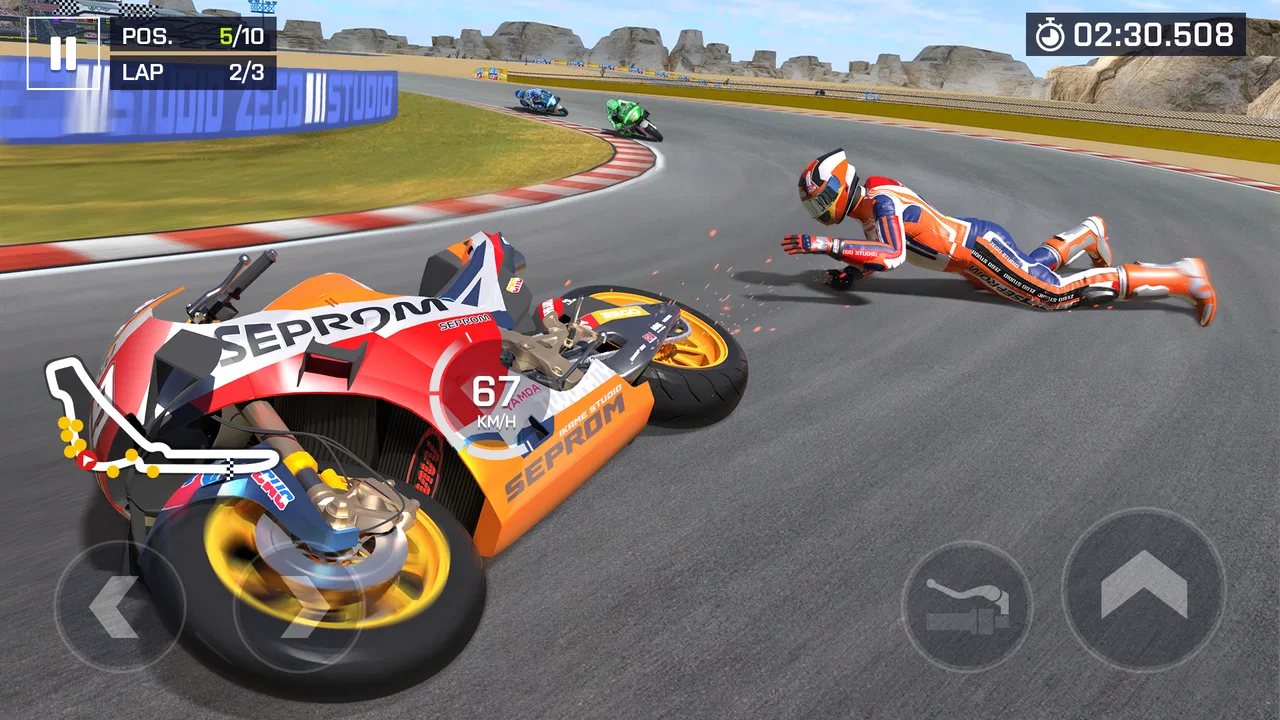
Moto Rider, Bike Racing Game
- 4.5
- Rating
- 100.00M
- Installs
- Free
- Price

 Analysis by App-foxy
Moto Rider is the kind of racing game I open when I want a quick motorcycle ride without committing to a long session. It focuses on the simple pleasure of moving through traffic, reacting quickly, and trying to improve the next run. That straightforward approach is its biggest strength, but it also explains why some players will eventually want more depth than it offers.
Developed by iKame Games - Zego Studio, this free racing game has built a very large audience, with over 100 million installs and a 4.5 average from around 239 thousand ratings. Those figures suggest that its basic loop is easy to understand and broadly appealing. In my experience, the game works best when treated as a compact reflex challenge rather than as a full motorcycle simulation.
How the first rides feel and what the basic workflow looks like
The first useful habit is to stop thinking of each attempt as a complete race. I approach a run as a short exercise in reading traffic, choosing a safe line, and deciding when a risky move is actually worthwhile. That mindset makes the controls feel less frantic and gives the game a clearer rhythm.
You May Also Like

 Pandora - Music & Podcasts
Pandora’s Music Is Easy to Start, but Harder to Recover
Pandora’s strength is its low-effort path from a seed to a station. Its weak spot is how much confidence it asks you to place in connection, setup, and quiet recovery.

 8 Ball Pool
 Is Built on Rivalries, Rematches, and Routine
A close look at the rivalries, rematches, shared routines, and unanswered safety questions that turn a quick pool match into a persistent mobile community.

 Samsung Music
’s Quiet Strength Is Playing What You Already Own
Its reach comes less from spectacle than from dependable access to a personal library. That simplicity is both the app’s strongest retention engine and its ceiling.

 AccuWeather: Weather Radar
AccuWeather Review: A Quick, Clear Forecast for Everyday Decisions
For everyday plans, the best forecast is the one you can understand quickly. AccuWeather makes rain timing, radar, and local conditions easy to act on, with a few trade-offs.

 Hill Climb Racing
Why Hill Climb Racing Still Turns Crashes Into One More Run
A tiny car, a bumpy hill and one more upgrade: Hill Climb Racing keeps resurfacing because its simple chaos makes every near-miss feel personal.

 AliExpress - Shopping App
AliExpress Makes Global Shopping Feel Personal, but Shoppers Bear the Risk
AliExpress turns a global marketplace into a pocket-sized discovery engine. Its reach is useful, its shopping loop compelling, and its trade-offs easy to miss.
More From Our News Desk
View All News


The usual session is simple: start riding, watch the road, avoid collisions, and use the available space intelligently. There is no need to learn a complicated racing rulebook before enjoying it. The appeal comes from the immediate response between a decision and the motorcycle’s movement. When I make a clean pass, the result feels earned because it depends on timing rather than on a long preparation phase.
For an everyday example, I can imagine playing during a short break while waiting for an appointment. I would begin with one relaxed run to settle into the speed, then use the next attempts to correct one mistake at a time. If I repeatedly move too early around traffic, I focus on holding my line longer. If I hesitate and lose a safe opening, I work on making the decision sooner. This turns a casual game into a small, repeatable practice routine.
That workflow is more satisfying than simply restarting after every mistake without thinking about it. The game is at its best when each attempt teaches me something about spacing and timing. It is not a motorcycle training tool, of course, but it does reward a similar kind of visual discipline: look ahead, avoid tunnel vision, and do not let one tempting opening dictate the entire run.
New players should resist the urge to make every pass as close as possible. A narrow gap may look exciting, but a slightly wider route is often the better choice when the road is changing quickly. I found that staying calm produces longer, more consistent sessions than constantly chasing the most dramatic move.
The game’s free entry also makes this workflow easy to try. It is rated for Everyone, so it is positioned as accessible rather than as a mature or highly technical racing experience. The trade-off is that players looking for realistic bike handling, detailed race strategy, or a deep career structure may find the central loop too light.
Settings I would check before trying to improve
Before chasing better results, I would spend a moment checking the available control and presentation settings on the device. Small changes in steering sensitivity, sound, vibration, or visual comfort can affect how confidently I react. I would not assume that the default arrangement is ideal for every phone or every player.
Control comfort matters especially during short-distance decisions. If steering feels too sensitive, I would make smaller movements and hold the phone steadily instead of constantly correcting. If the response feels slow, I would check whether my grip is causing accidental input or whether the chosen control method suits the way I naturally use the screen. The important point is to change one thing at a time, then play enough to judge it fairly.
Sound is also more useful than it first appears. Keeping audio at a comfortable level can make a session feel more responsive, but I would lower it when playing in public or when I need to concentrate on the visual flow. Vibration, if available on the device and enabled in the game, can be helpful for feedback, though some players may find it distracting during repeated attempts.
Screen brightness deserves attention too. A very dim display can make distant traffic harder to read, while excessive brightness can make a longer session uncomfortable. I prefer a middle setting that keeps the road clear without turning a short game into an unpleasant battery-heavy activity.
Another practical setting is the phone’s own notification behavior. I would silence interruptions before starting a serious attempt, not because the game requires a long uninterrupted campaign, but because a notification at the wrong moment can ruin a carefully timed move. This is a small preparation step, yet it makes the experience feel much more controlled.
Players should also be realistic about in-app purchases. The game is free to download, while individual purchases range from $1.99 to $99.99. I would begin without spending anything and first decide whether the core riding loop remains enjoyable after several sessions. A purchase can make sense for someone who already knows they will play regularly, but it is harder to justify if the main attraction is only a few minutes of occasional entertainment.
Repeatable patterns that make riding more consistent
Once the controls feel comfortable, I use a simple three-part pattern: scan farther ahead, choose a target lane, and keep an escape option in mind. Looking only at the motorcycle’s immediate position makes every obstacle feel sudden. Looking farther down the road gives me time to prepare instead of reacting at the last possible instant.
I also avoid changing direction repeatedly without a reason. Rapid left-right corrections may feel active, but they often create more risk than they remove. A better pattern is to make one deliberate move, settle the bike, and reassess the next opening. This is particularly useful when traffic creates several possible routes and the nearest gap is not necessarily the safest one.
A useful practice is to separate safe progress from score chasing. During one run, I might concentrate only on surviving and learning the traffic rhythm. During the next, I can take more ambitious lines. Mixing both goals in every attempt makes it difficult to understand why a run failed. Separating them gives me clearer feedback.
I would also use short sessions rather than forcing a long streak after concentration starts to fade. Reflex games can become less enjoyable when every mistake feels like a personal failure. Taking a brief pause after a few poor attempts helps me return with better attention. This is not a feature of the game, but it is one of the most effective habits for getting more from it.
Another non-obvious advantage of repeatable routines is that they reveal whether a problem is caused by judgment or by control. If I keep choosing the wrong gap even after the controls feel stable, I need to improve my reading of traffic. If my decisions seem correct but the bike continually drifts past the intended line, I should revisit the control setup. Diagnosing the problem prevents random changes that only create more confusion.
For players moving from other mobile racing games, the adjustment is important. Traditional car racers often reward braking points, cornering lines, or controlled acceleration. Here, I find that the immediate challenge is more about lane placement and reaction timing. Someone who enjoys drifting or long circuit races may prefer a different game, while someone who likes quick traffic decisions will probably understand the appeal quickly.
Where the game rewards experience and where it stops
Experienced play is less about discovering a secret trick and more about reducing unnecessary decisions. I try to establish a comfortable line early, avoid chasing every opportunity, and treat dangerous openings as optional rather than mandatory. The strongest improvement comes from consistency: making the same good choice repeatedly instead of occasionally producing a spectacular pass.
It also helps to recognize when a run has become unstable. After a near miss, I do not immediately attempt another aggressive move. I first return to a safer position and rebuild a clear view of the road. This recovery habit is valuable because one risky decision often encourages another, creating a chain of mistakes that could have been avoided by slowing the pace of my thinking.
There is a limit to how much planning the game can support. Its appeal is immediate action, not an elaborate system of vehicle tuning, team management, or strategic race preparation. If I want a detailed motorcycle career with extensive customization and long-term progression, I would look toward a more specialized racing title. Moto Rider is better suited to players who value accessibility and quick repetition over simulation depth.
That limitation also affects replay value. The first sessions are easy to understand and inviting, but players who need a constantly expanding set of objectives may eventually feel that the central activity is familiar. I see that as a fair trade-off for the game’s low barrier to entry, not as a flaw that can be solved by pretending it is a different kind of racing game.
The current version is 1.148, and the store highlights a latest update focused on motor racing innovations. That gives returning players a reason to check the game again rather than assuming it has remained exactly as they remember. Still, I would judge the experience primarily by whether the riding loop itself remains enjoyable, because updates cannot change the fact that this is designed around quick motorcycle action.
Device compatibility is reasonably broad, with Android 7.0 or later required. That makes it approachable for people using older supported phones, although the actual comfort of play will still depend on the screen, responsiveness, and battery condition of the device. A smaller display may make traffic reading more demanding, while a larger one can make control gestures feel more natural.
Who should play it and who should choose another racer
I would recommend it to someone who wants a free motorcycle game that can be understood immediately and played in short bursts. It is a good fit for commuters, casual players, and anyone who enjoys improving through repeated reflex-based attempts. It also works for players who prefer learning a small set of habits rather than studying a complicated upgrade tree.
I would be more cautious recommending it to a player who expects realistic physics, detailed bike customization, multiplayer competition, or a substantial story-driven campaign. Those expectations belong to a different type of racing game. Choosing Moto Rider for them could lead to disappointment, not because the game fails at its purpose, but because its purpose is narrower.
Parents may appreciate the Everyone content rating, while still remembering that optional purchases are present. I would let a younger player try the free experience first and discuss spending before allowing purchases. The broad age rating describes the content style, but it does not automatically make every monetization decision suitable for every household.
Compared with a conventional arcade racer, this game feels more immediate and less demanding in terms of setup. Compared with a motorcycle simulator, it is much lighter and more forgiving as an entry point. Its middle ground is useful: it gives me the sensation of riding through changing traffic without asking me to master a complete simulation model.
My verdict after using the full routine
The best way to enjoy Moto Rider is to treat it as a focused reflex game, not as a complete motorcycle simulator. Once I adjust the controls, silence distractions, scan ahead, and separate safe practice from risky attempts, the experience becomes more satisfying than its simple premise might suggest.
Its strongest quality is the ease with which I can start a session and understand what I need to improve. Its main weakness is the limited depth for players who want a broader racing structure. The free price makes trying it straightforward, but the presence of optional purchases means I would wait before spending and make sure the basic loop has lasting appeal.
Overall, I think Moto Rider earns its place as a casual racing option. It is not the game I would choose for realistic bike physics or a long competitive campaign, but it is one I can recommend when the goal is a quick ride, a few tense decisions, and a clear opportunity to get better on the next attempt. For that specific use, the work of iKame Games - Zego Studio is direct, accessible, and genuinely enjoyable.
FAQs for Moto Rider, Bike Racing Game
01What are the main features of Moto Rider, Bike Racing Game?
Moto Rider offers an immersive racing experience with realistic bike physics and stunning graphics. Players can choose from a variety of bikes and customize them with upgrades. The game includes multiple modes, such as time trials and multiplayer races, providing both solo and competitive gameplay options. Expect smooth controls and challenging tracks.
02Is Moto Rider, Bike Racing Game free to play, and are there in-app purchases?
Yes, Moto Rider is free to download and play. However, it includes in-app purchases that allow players to buy additional bikes, customization options, and other game enhancements. While these purchases can enhance gameplay, they are not necessary to enjoy the full experience of the game.
03What are the system requirements for Moto Rider on Android and iOS?
Moto Rider requires Android version 5.0 or higher and iOS 11.0 or later. Ensure you have sufficient storage space, as the game file is moderately large. It's also recommended to have a device with at least 2GB of RAM for optimal performance, ensuring smooth graphics and gameplay.
04How does the multiplayer mode work in Moto Rider, Bike Racing Game?
In multiplayer mode, players can compete against friends or other online racers in real-time. The game features leaderboards and ranking systems to track progress and achievements. Players can join races through matchmaking or invite friends directly. This mode enhances the competitive aspect of the game significantly.
05Are there any tips for beginners in Moto Rider, Bike Racing Game?
Beginners should start with the tutorial to understand the controls and game mechanics. Focus on mastering basic maneuvers before progressing to more challenging tracks. Upgrading your bike gradually can enhance performance. Also, practice on different tracks to improve your skills and explore various game modes for a well-rounded experience.
Pros
- Realistic bike physics enhance gameplay.
- Variety of bikes to unlock and customize.
- Smooth graphics with dynamic environments.
- Challenging levels keep players engaged.
- Intuitive controls make it easy to play.
Cons
- In-app purchases can be costly.
- Ads are frequent and sometimes disruptive.
- Limited offline play options available.
- Occasional lag on older devices.
- Repetitive music can become annoying.

Moto Rider, Bike Racing Game
Gallery